
PRICELESS SA: Search results worth citing
PRICELESS SA: Search results worth citing
Their work sits at the intersection of evidence and health policy, which means their publications aren't just content. They're the product.
The site runs on Plone 6 with a Volto front-end (our home turf). When they came to us in 2025, the ask was straightforward: help their academic team (and the people who rely on their research) actually find what they're looking for.
The Challenge
PRICELESS SA doesn't host their publications directly. Like many academic units, they link out to externally hosted resources. That's standard practice.
Three things needed to work better on their Resources page:
Publications needed to display in proper academic citation format, not just a title and a URL.
Authors needed to be searchable, because researchers often look for work by a specific person.
Users needed to be able to browse by year, the way academics naturally think about literature.
None of these were insurmountable. But each one required a considered solution.
What we built
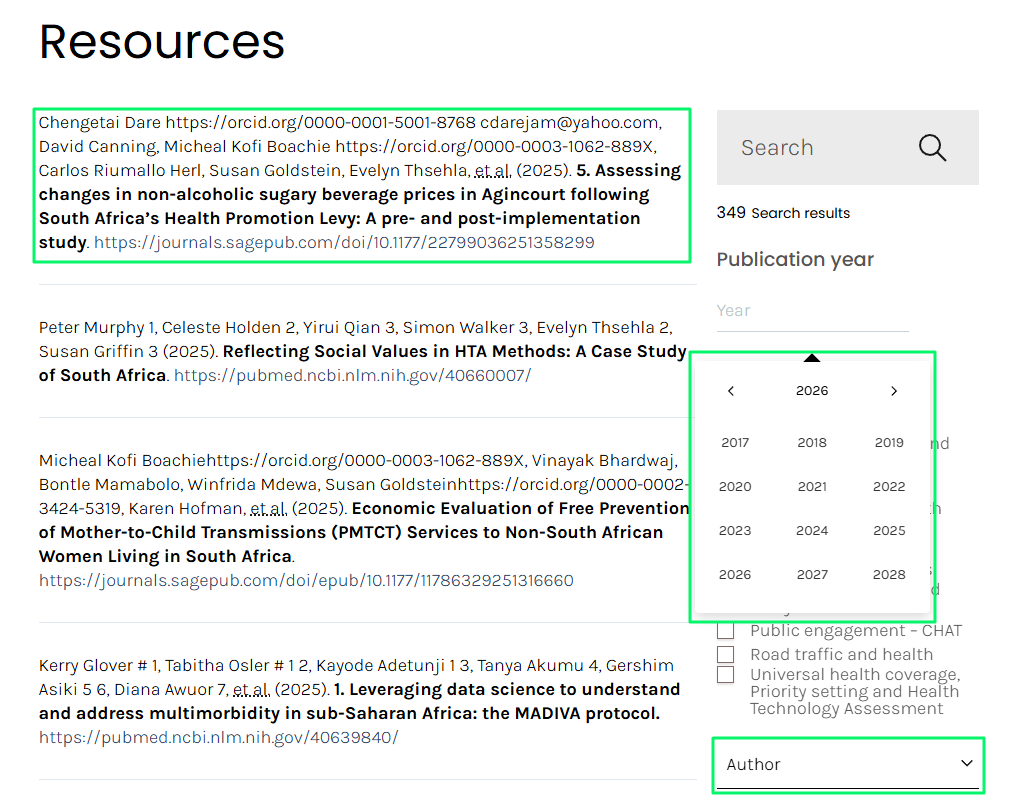
Search by author
The issue: Researchers would want to filter the list of results by a specific person. But author names weren't searchable, and a quick fix would have exposed system users like Admin alongside actual researchers.
The fix: We gave editors a dedicated author field - a way to control exactly which names appear, and those names become properly searchable.
Under the hood: Plone's default "creators" field isn't indexed for search, and exposing it directly creates some awkward collisions with system users. We extended the link content type with a custom author field: clean, controlled, and search-ready.
Filter by year
The issue: Academics think in years. "What came out in 2021?" is a completely natural question, and a generic date range picker is a clunky way to answer it.
The fix: We swapped out the default date filter for a clean, year-based facet. One click, one year, all the publications from that period.
Under the hood: This involved component shadowing to customise the date range facet, a Volto pattern that lets us override default behaviour without touching core code.
Citations that look like citations
The issue: Academic publications deserve academic formatting. A title and a URL doesn't cut it when your audience includes researchers, policymakers, and funders who expect to see a proper citation.
The fix: Editors fill in structured fields when adding a resource (author, journal, year, and so on) and the site does the rest, rendering everything into a consistent academic citation format automatically. No hand-formatting. No guesswork.
And because academic research is often a team sport (we've seen papers with 20-plus authors), we keep the listings clean by showing only the first few authors by default. Hover over the entry and the full author list appears.
Under the hood: We introduced a citation template within the listing block, with author truncation handled via a hover interaction, so the "et al." is always just a moment away.
The result
The Resources section now works the way an academic team expects it to. Editors have a predictable, structured workflow. Visitors can search by author, filter by year, and read citations in a format they recognise.
A focused set of enhancements, applied in exactly the right places, turned a static list of links into a genuinely useful research tool. And resulted in a happy client.
Visit the site at pricelesssa.ac.za